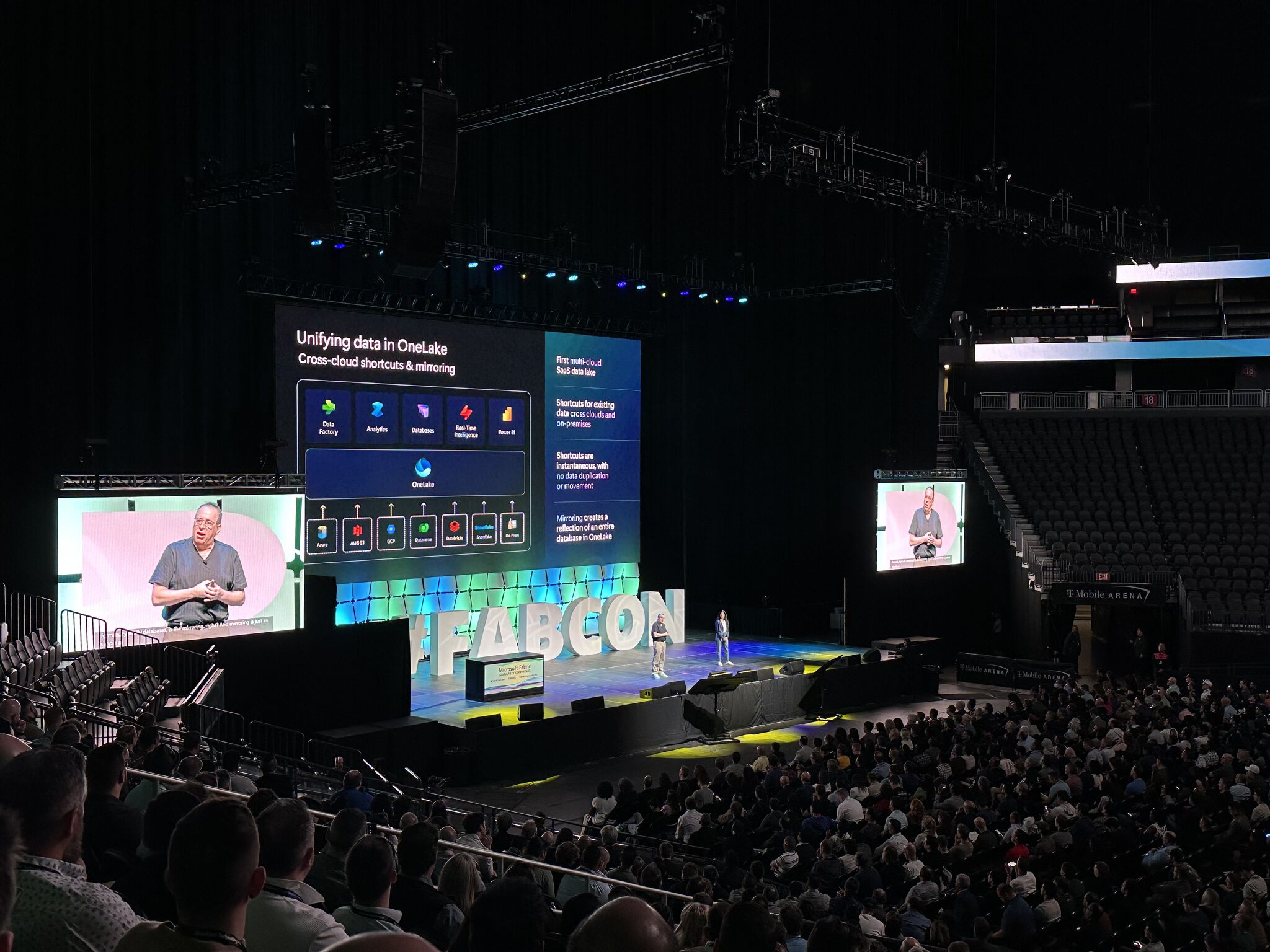

Las Vegas. Microsoft Fabric. And a bet so big it made me stop and think twice.
Of the three Microsoft events I attended in 2025, Fabcon was the most underrated — and arguably the most consequential for enterprise architecture.
Build gets the headlines. Ignite gets the enterprise crowds. But Fabcon is where Microsoft laid out the most ambitious piece of the entire puzzle:
What if data, analytics, and AI weren’t three separate stacks — but one?
The bet Microsoft is making with Fabric
Microsoft Fabric isn’t a product upgrade. It’s a platform consolidation play aimed squarely at Snowflake, Databricks, and the broader modern data stack.
The vision: one data lake (OneLake), one compute engine, one governance layer — powering everything from real-time analytics to AI pipelines to Power BI dashboards.
If it works, organizations no longer need:
- A separate data warehouse
- A separate ML/AI pipeline
- A separate BI stack
- A separate governance tool
That’s not a small claim. And at Fabcon, Microsoft showed enough of the execution to make it credible.
The Copilot angle inside Fabric — more significant than it sounds
Natural language querying in BI tools has been a promise for years. Most implementations disappoint. What Microsoft is building inside Fabric feels different — not because the technology is magic, but because it’s integrated at the data layer, not bolted on top.
When Copilot lives inside the pipeline — not just the UI — you get:
- AI-assisted data preparation, not just AI-assisted reporting
- Automated insight generation from structured and unstructured data together
- Natural language as a genuine interface for data engineering tasks
Data teams are going to look very different in three years. The technical floor is rising, but so is the leverage each person has.
Governance built-in: the thing that actually matters

This is where Fabcon stood apart from every other data platform conversation I’ve had this year.
Purview integration isn’t an add-on in Fabric — it’s architectural. Sensitivity labels, data lineage, classification, and access controls are wired into the platform from the ground up. You get visibility into where data came from, how it’s classified, who can access it, and where it’s going.
For anyone working in regulated industries — financial services, healthcare, government — this matters enormously. You’re not retrofitting governance onto a data platform. It’s there from day one.
This is also why Fabric matters for AI. Governed data feeds better, safer, more reliable AI. The Fabric + Purview combination is Microsoft’s answer to the question every CISO is asking: “How do we let AI touch our data without losing control of it?”
The honest challenge
I won’t oversell this. Fabric is powerful — but it requires maturity to use well.
If your data is a mess (and most organizations’ data is a mess), moving it into Fabric doesn’t fix the mess. It centralizes it. And centralized chaos is still chaos — just easier to see.
To get real value from Fabric you need:
- Data modeling discipline before you migrate
- Governance maturity — classification, labeling, lineage thinking
- Identity alignment across your data and AI consumers
Sound familiar? It’s the same foundation I’ve been writing about in the AI Readiness series. The pattern holds across every platform: governance first, technology second.
Bottom line
Fabcon 2025 confirmed something I’ve believed for a while: data infrastructure is AI infrastructure. They’re not separate roadmaps anymore.
Microsoft is making a generational bet that the organization that controls the data platform controls the AI platform. Fabric is that bet in product form.
Whether you’re a Fabric customer yet or not, the direction is worth paying attention to. Because the organizations that get their data house in order now — governed, classified, unified — are the ones who will actually be able to move when AI demands it.
And it will demand it. Sooner than most people think.
— Jean-Paul Abi Atme